
INWED 2026: What Does Engineering Intelligence Mean to You?
Guest blog by Dr Rebecca Weston CB FREng FNucI
To mark International Women in Engineering Day 2026 (#INWED26), Dr Rebecca Weston CB FREng FNucI reflects on this year's theme, Engineering Intelligence, following an event hosted by the Royal Academy of Engineering.
Rebecca is a Fellow of the Royal Academy of Engineering, Fellow of the Nuclear Institute and was recently appointed a Companion of the Most Honourable Order of the Bath (CB) in the King's Birthday Honours. In this guest blog, she explores the role of engineering judgement, diversity of thought and professional collaboration in tackling complex challenges across the nuclear sector.
The 2026 theme for International Women in Engineering Day (INWED26) is Engineering Intelligence.
What does Engineering Intelligence mean to you?
This was the opening question posed by Dame Tamara Finkelstein at her first INWED event last week as the Royal Academy of Engineering CEO. (This is a good point at which to add to many others my congratulations to the previous CEO, Dame Hayaatun Sillem, who was recognised in this year’s King’s Birthday Honours, not least for her incredible contribution to inclusivity and diversity in engineering.)
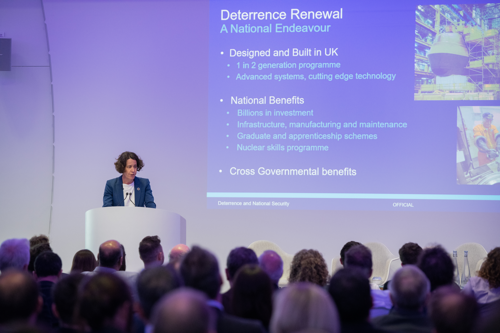
For the first time in a few years, I was able to join this annual RAEng event, where Fellows can invite earlier career engineers to network and be inspired by colleagues across the breadth of engineering. Nuria Ruana Miro from Dungeness (Nuclear Restoration Services) joined me (thanks for the nomination from the NDA Group Talent team) and we shared a lively table mixing academics, industry and professional services. As ever at RAEng events, top academics, mix with influential government officials, Chief Scientific Advisers, founders and big business.
Including a good spattering of nuclear influence in the audience, including Dame Fiona Rayment and Professor Zara Hodgson from University of Manchester.
Engineering Judgement in Complex Systems
Engineering Intelligence for me means bringing engineering judgement to bear. That combination of skills, experience that – with a clear eyed view of the outcome seeking to be achieved within the system at hand – takes all the hard data and analysis, adds the softer nuance of the context and environment (with an undercurrent of imagination and creativity) and enables decisions to be taken with a considered balance of risk. The right decisions for the project, the facility, the team, the system in that moment.
It’s not having the best technical mind, it blends leadership, ingenuity, curiosity, humility and a questioning attitude – alongside brilliant technical capability and conviction.
This is something I think about a lot, having had to balance system risk and prioritisation choices across complex and diverse systems across my career in nuclear! It is not easier and doesn’t get any easier. It is also fundamentally at the heart of why the regulatory taskforce was necessary and why the industry is finding it so hard to embrace. Tamara’s quote from last week seems relevant here “It is hard because it is hard, not because we are stupid.”
Data, Models and Decision-Making
This will make it into my very short list of very easy to remember quotes. A tried and tested favourite relevant to this subject that springs to mind is “some models are useful, all are wrong.” I.e. you can use all the tools and modelling you like, collect more data, map out the options, but ultimately there is no getting away from applying judgement, particularly in complex systems. It applies as much if not more now and going forward as decision support tools become more and more sophisticated and AI agentic agents continue to mature. The intelligent use of data and models has and will continue to revolutionise humanity at an even greater rate. However, poorly implemented, things will be poorer for it, more complicated, less impactful, with more frustrating processes and systems impacting outcomes.
Different Perspectives, Better Outcomes
So, to tie this back to INWED and engineering intelligence, ingenuity and humility. We can apply different, tangential, unique perspectives on difficult system challenges if we can explain the outcome and the challenge in a way that all can see it and then contribute to solving it and if we make it visible to a wider range of different perspectives. It is something I have actively tried to embrace throughout my career, that various people have found at times irritating, more often empowering. However, I am only ever increasingly convinced this is the way forward!
A Role for the Whole Nuclear Profession
That absolutely includes a lot more women engineers, but more besides. As a final observation, as nuclear in the UK seeks to deliver on the broadest front for two generations, the Nuclear Institute has a significant role to play as the professional membership body for everyone working in the nuclear industry. A distinguishing feature as compared to many professional bodies, it is open to all who work in the industry, not just engineers or scientists, operators, health physicists, lawyers, accountants, project managers, IT, administrative, security professionals or many other professions. Embracing the different perspectives and aligning around common outcomes, improving the professionalism in the nuclear sector is a good example of engineering intelligence.